
AI
Omen AI’s Plan to Optimize Data Centers Is All Wet

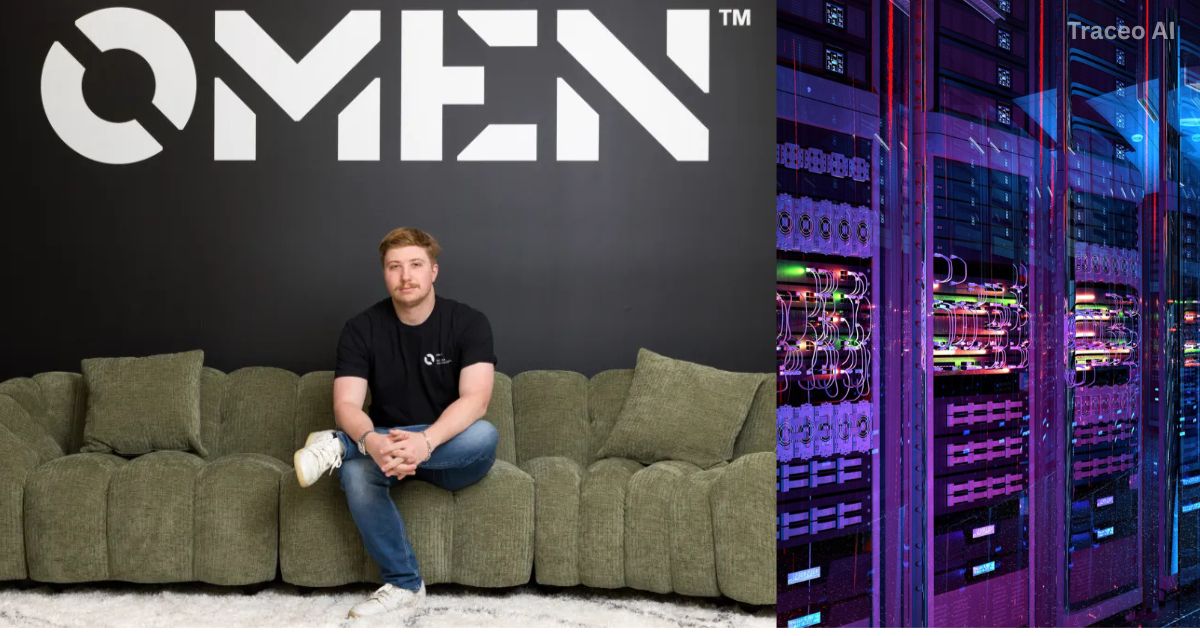
AI boom’s strangest bottleneck isn’t chips or power
Every conversation about the limits of artificial intelligence infrastructure tends to circle back to the same three culprits: not enough GPUs, not enough electricity, and not enough land to build on. Those are real constraints, and they dominate the headlines. But a fourth, far less glamorous problem has quietly become one of the most expensive risks inside a modern AI data center — and it has nothing to do with semiconductors or megawatts. It’s the fluid running through the pipes.
As chipmakers push GPUs to ever-higher thermal limits, data center operators have leaned hard into liquid cooling, piping a mix of water and anti-microbial additives directly to the surface of the chip to pull away heat that air alone can no longer handle. It works. But it also creates a new failure mode that didn’t really exist in the air-cooled era: the coolant itself can grow something nasty inside it, clog the system, and force an operator to shut a multimillion-dollar rack down for half a day just to flush the lines.
A four-year-old startup called Omen AI thinks it has a fix, and on June 29 it told TechCrunch it had raised a $31 million Series A to scale it up. The round, and the unusual founder behind it, offer a window into one of the stranger but increasingly important corners of the AI infrastructure buildout: the plumbing.
Why a data center’s cooling loop is a chemistry problem in disguise
To understand what Omen AI is selling, it helps to understand what’s actually happening inside a liquid-cooled server rack. Modern AI accelerators run far hotter than the CPUs that preceded them. Industry estimates put GPU thermal design power on a path toward roughly 1,000 watts per chip by 2026 and 2027, a level that has effectively ended the era of air cooling as a stand-alone solution for high-density AI clusters. Analysts at Goldman Sachs have projected that the share of AI servers using liquid cooling will rocket from about 15% in 2024 to over three-quarters by the end of 2026, and direct-to-chip systems — where coolant runs through metal plates pressed against the chip itself — are expected to remain the dominant architecture as rack densities push past 60, then 100, kilowatts.
Direct-to-chip systems typically circulate a mixture of water and propylene glycol or a similar additive. The additive does double duty: it lowers the freezing point and, critically, it inhibits the growth of bacteria, algae, and fungi inside what is otherwise a warm, nutrient-rich, oxygenated environment — exactly the kind of place microorganisms like to live. Industrial cooling engineers have understood this dynamic for decades in cooling towers and HVAC systems, where uncontrolled microbial activity is known to accelerate corrosion, degrade heat-exchange efficiency, and in the worst cases create the conditions for pathogens such as Legionella to take hold.
Operators chasing more performance face a trade-off. Plain water absorbs and carries heat more efficiently than a water-glycol blend, so a data center manager looking to run chips hotter and squeeze more compute out of every rack has an incentive to thin out the protective additive and lean more on water. That same shift, however, makes the fluid more hospitable to bacterial growth. Left unchecked, that growth forms a biofilm — a sticky, self-protecting layer that can block narrow cooling channels, reduce heat-transfer efficiency, and contribute to corrosion of the pumps and seals it touches.
When that happens, there’s only one real fix: drain the loop, flush it, and refill it with clean fluid. For a single rack, that maintenance window can run five or six hours. For an operator running a fleet of AI training clusters that customers are paying by the hour to use, an unplanned multi-hour outage on a high-value rack can cost millions of dollars in lost revenue and service-level penalties — without anyone necessarily knowing the outage was coming until flow rates had already started to drop.
Most facilities currently manage this risk the same way industrial cooling plants have for decades: by periodically pulling a fluid sample and shipping it to a lab. That approach works, but it is slow by definition, often returning results long after a problem has already started to compound inside the loop.
None of this is a hypothetical risk dreamed up by a startup pitch deck. Industrial engineers have documented bacterial fouling of closed-loop cooling systems for decades, including a well-known case from a Boston hospital in the late 1970s in which a strain of Pseudomonas bacteria, fed by trace amounts of antifreeze additive, fouled the heat-exchanger tubes of a chilled-water system badly enough to knock out air conditioning across patient-care areas. The mechanism is essentially the same one data center operators now have to worry about: a warm, nutrient-bearing, recirculating loop is close to ideal habitat for certain bacteria, and once they establish a foothold they don’t just float freely in the fluid — they build a protective biofilm on interior surfaces that shields them from the very biocides meant to kill them. That biofilm is the real long-term threat, since it can keep regenerating even after a single flush, and conventional plate-count lab testing of bulk fluid samples can miss it almost entirely, because the bacteria embedded in surface biofilm can outnumber the free-floating bacteria in the water itself by several orders of magnitude.
A spectrometer for your chip coolant
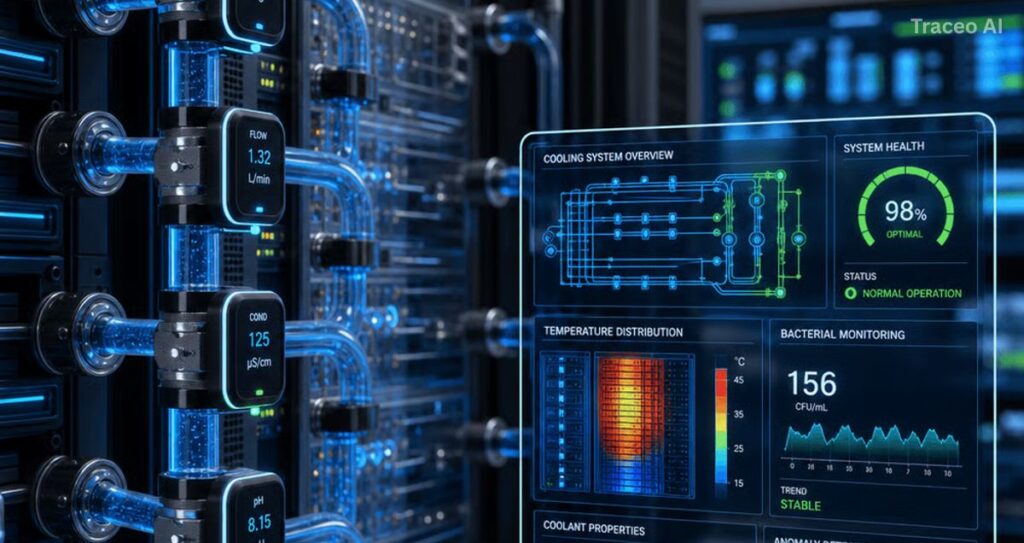
Omen AI’s pitch is to replace that lab-and-mail cycle with continuous, real-time visibility. The company has built a miniaturized spectrometer that sits on the cooling loop itself and reads the chemical state of the fluid as it flows, flagging early signs of bacterial growth before it turns into a clog. Founder and CEO Zach Laberge frames the value proposition around eliminating the kind of surprise downtime that comes from operators having no ongoing insight into what is happening chemically inside their own systems.
The same sensing approach extends beyond bacteria. According to Laberge, the device can also pick up early indicators of mechanical wear elsewhere in the system — traces of copper or chromium in the fluid can point to a pump that’s degrading, while silicon can be a tell for a failing seal. In effect, Omen is trying to give a cooling loop something like a continuous blood panel, rather than the equivalent of an annual physical.
Laberge has described the underlying breakthrough as less about any single dramatic invention and more about timing: optical sensing hardware has become cheap enough to deploy widely, while advances in signal-processing software have made it possible to extract a meaningful chemical signal out of what would otherwise be noisy real-world data. That combination — inexpensive hardware paired with software that can make sense of it at scale — is a pattern showing up across a lot of recent industrial-monitoring startups, and it’s central to Omen’s bet that it can offer something genuinely better than mail-in lab testing at a price point operators will actually pay.
From construction sites to server rooms
Omen AI’s arrival in data centers is itself a bit of an accident — or at least an opportunistic pivot. Laberge’s path into the fluid-monitoring business started years before AI data centers were the obvious bet they look like today, and his backstory is unusual even by startup standards.
Laberge launched his first company in 2020, at 14 years old, raising $3 million to put sensors on heavy construction equipment, and dropped out of high school to run it. His parents — his mother a former Ontario Minister of Education — reportedly backed his decision to take that path. That first venture eventually shut down, but in 2024 Laberge started over with Omen, this time built around a simpler thesis: fluid systems are the key to making machinery smart enough to flag its own problems before they become expensive failures, and replacing slow lab sampling with real-time sensing was the way to do it.
That thesis came directly out of what he’d seen go wrong at his first company. Heavy construction equipment — excavators, dozers, cranes — depends on hydraulic fluid the same way an AI server depends on coolant: as a closed loop that quietly carries information about the health of the whole machine, if anyone bothers to look. A worn pump sheds metal into hydraulic fluid the same way a degrading data center pump sheds copper or chromium into coolant. A failing seal leaches silicon into the line in both cases. Laberge’s bet, in other words, wasn’t really about construction equipment or data centers specifically — it was about fluid as an underused diagnostic medium, with a sensing and software platform built to read it wherever it shows up. That generality is part of why the pivot into data centers came together so quickly once the opportunity presented itself; Omen wasn’t building a new product from scratch, it was pointing an existing one at a new and far larger building.
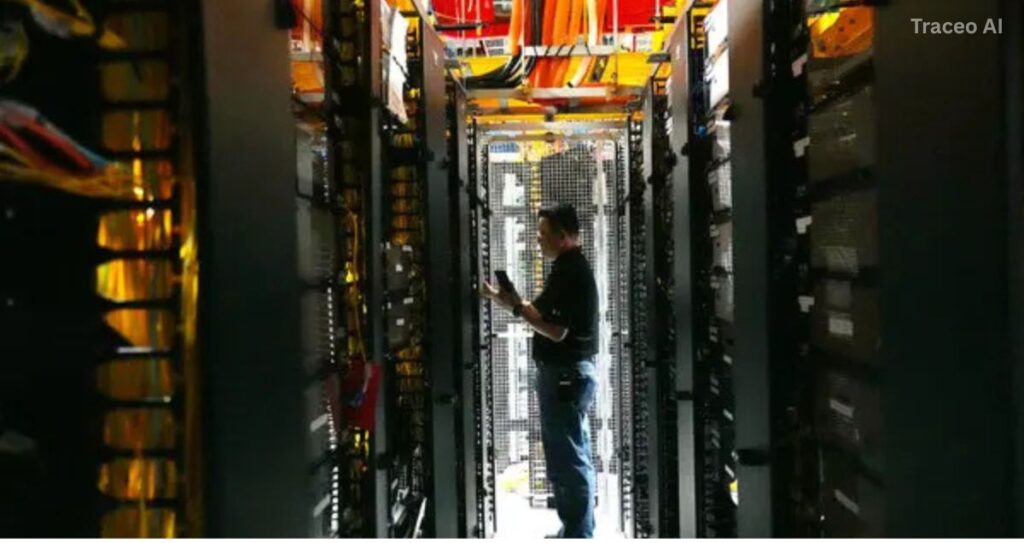
Caterpillar dealerships became an important early customer base for Omen’s original heavy-equipment business. That relationship turned out to be the bridge into data centers. Caterpillar isn’t only a maker of bulldozers and excavators — it’s also a major supplier of the gas turbines and backup generators that data center operators increasingly rely on for on-site power, a business that has become a meaningful growth driver for the industrial giant as AI campuses outpace what local utility grids can deliver. Roughly six months before the Series A announcement, some of those same Caterpillar dealerships that were already fitting sensors to turbines for data center customers started asking Omen whether it could extend the same approach to the buildings themselves.
That question led Omen to look inside the buildings its dealership partners were already serving — and to discover that data centers are full of fluid systems well beyond the generators out back, from HVAC loops to, increasingly, the direct-to-chip cooling running through every AI rack. Recognizing a fast-growing customer base hiding in plain sight, Omen shifted its focus toward data center operators.
The Series A, and who’s backing it
Omen’s $31 million Series A was led by Nava Ventures, with participation from CRV, Vanderbilt University, Mann+Hummel, Starhill Holdings, and Hard Launch Capital, along with personal investments from executives at Bridgestone, GM, Johnson Controls, and TensorWave. The round brings Omen’s total funding to $40 million since its 2024 founding.
The investor list is notable for who’s on it: it isn’t a roster of pure AI-infrastructure funds, but a mix that includes industrial and automotive players — Bridgestone, GM, Johnson Controls — whose executives presumably recognize the underlying fluid-monitoring problem from their own supply chains, alongside Mann+Hummel, a filtration and fluid-systems manufacturer. That blend suggests Omen’s pitch is landing as much with people who understand industrial fluid chemistry as it is with traditional AI-infrastructure investors.
Cory Rellas, a partner at Nava Ventures who joined Omen’s board as part of the round, has pointed to Laberge’s age as part of what stood out during diligence — noting that it’s unusual for a founder this young to already command credibility with large, established industrial customers in a sector that typically moves slowly. Rellas has said much of the firm’s confidence came less from modeling the market in the abstract and more from conversations with Omen’s existing large customers, which validated the approach directly.
Omen says it’s currently working with about a dozen data center customers as it builds out its product for that market. One of them, TensorWave — the Las Vegas-based company building an AI compute cloud entirely on AMD’s Instinct accelerators rather than Nvidia’s GPUs — also has executives who personally invested in the round. TensorWave has been on its own rapid funding trajectory, closing a $43 million SAFE round in October 2024, a $100 million Series A in May 2025, and a $350 million Series B in June 2026 at a $1.55 billion valuation, as it builds out AMD-based clusters across data centers in Arizona, Pennsylvania, and Florida and works toward more than 2 gigawatts of long-term data center capacity. TensorWave’s president, Piotr Tomasik, framed coolant chemistry as a variable the broader industry has been flying blind on, and described Omen’s monitoring approach as aligned with how TensorWave wants to see infrastructure evolve to better support its compute customers.
That a customer’s executives would also write personal checks into a vendor’s funding round is itself a signal worth noting. It’s not unusual in enterprise software, where a customer champion might angel-invest in a tool they already rely on internally, but it’s a less common pattern in industrial hardware, where sales cycles are longer and the line between vendor and investor is usually kept further apart. The fact that it’s happening here suggests the people actually running AI clusters day to day see coolant chemistry as more than a nice-to-have dashboard — they see it as a genuine operational risk worth having a financial stake in solving.
A market that’s suddenly worth fighting over
Omen isn’t alone in spotting the opportunity. Pyxis, an established water-treatment and monitoring company, launched its own data center coolant-monitoring product earlier in June 2026, underscoring that incumbents in industrial water treatment are racing toward the same opportunity from the other direction — bringing decades of cooling-tower and HVAC chemistry expertise to a newly lucrative AI-adjacent market rather than building sensing technology from scratch the way Omen has.
That competitive interest makes sense given how fast the underlying liquid-cooling market itself is growing. Estimates vary by research firm and by exactly how the category is defined, but they all point in the same direction. Grand View Research puts the global data center liquid-cooling market at roughly $6.65 billion in 2025, growing at better than 20% a year toward nearly $30 billion by 2033. Dell’Oro Group, focused more narrowly on cooling-equipment manufacturer revenue, expects the segment to approach $7 billion by 2029, calling liquid cooling a now-essential requirement for large-scale AI deployments rather than the optional upgrade it once was. Other forecasts from Future Market Insights and Market Decipher put the AI-specific slice of that market in the $3.5–4 billion range in 2026, scaling toward $15–18 billion within a decade.
What all of those numbers describe is an industry-wide architectural shift happening in real time. Direct-to-chip cooling commands the largest share of that spending today, typically cited at somewhere between 42% and 47% of current market revenue, and immersion cooling — submerging entire servers in dielectric fluid rather than running coolant through plates on individual chips — is growing quickly behind it for the most extreme-density deployments, where rack power has pushed past what cold plates alone can handle. Either way, fluid is no longer a peripheral utility hanging off the side of a data hall; it has become as central to a facility’s design and operating cost as the chips it’s cooling. Regionally, North America still accounts for the largest share of liquid-cooling spending, helped along by hyperscaler capital spending and federal manufacturing incentives, while Asia-Pacific is growing fastest as Chinese hyperscalers like Alibaba and Tencent roll out immersion-cooled GPU clusters and Japan treats liquid cooling as something close to a national energy-efficiency priority.
That shift is exactly the wedge Omen AI and Pyxis are both trying to exploit: as fluid systems get more sophisticated and higher-stakes, the market for monitoring those systems — rather than just building and selling them — grows right alongside it. Industry forecasts from Market Decipher, in fact, single out monitoring, optimization, and predictive-maintenance services as the fastest-growing slice of the broader liquid-cooling category, even faster than the hardware itself, with one report pointing to a cooling-as-a-service segment expanding from roughly $1.2 billion to more than $34 billion over the coming decade as operators increasingly outsource the complexity of running these systems rather than building that expertise in-house.
The other fluid problem: power, not just water
Omen’s expansion into data centers via its Caterpillar relationship is also a reminder that the AI infrastructure boom’s challenges are deeply interconnected — cooling, power, and reliability are really one problem wearing three hats. Caterpillar’s own data center business has exploded alongside the same compute demand driving the cooling crunch, supplying the natural-gas turbines and generator sets that operators are increasingly using not just as backup power but as primary, on-site generation while they wait — sometimes years — for utility grid connections. Caterpillar executives have pointed to U.S. electricity demand growth on the order of 25% from 2023 to 2035 as the underlying driver, with the company expanding its gas-turbine manufacturing capacity by more than 125% over the same period to keep pace.
That power buildout and the cooling buildout are tightly linked: the same dense AI racks that need direct-to-chip liquid cooling are also the reason data centers are pulling 100-plus megawatts of power, often before the grid is ready to deliver it. Caterpillar has packaged turbines, generators, switchgear, battery storage, and combined cooling-heat-and-power systems into single integrated offerings for data center campuses, recognizing that operators don’t think about power and cooling as separate problems — they think about uptime. It’s not a coincidence that the same dealership network selling and servicing that power equipment was the one that first asked Omen whether it could bring sensor-based monitoring to the buildings behind the turbines, not just the turbines themselves.
Why the unglamorous infrastructure layer is suddenly investable
There’s a broader pattern here that goes beyond any one startup. As capital has poured into AI compute — with the largest cloud providers reportedly planning to spend more than $600 billion on infrastructure in 2026 alone — a parallel wave of investment has started flowing into the less visible systems that keep that compute running: power generation and storage, cooling architecture, networking, and now, fluid and chemical monitoring. None of these categories generate headlines the way a new foundation model does, but each one represents a place where a multi-hour outage or a hardware failure translates directly into lost revenue for a hyperscaler or neocloud customer paying by the GPU-hour.
That dynamic is precisely why a company like Omen, with origins in monitoring hydraulic fluid on bulldozers, can plausibly pivot into monitoring chip coolant in AI data centers: the underlying technical challenge — sensing chemical and mechanical degradation in a closed fluid loop before it causes a failure — turns out to be remarkably similar whether the fluid is keeping an excavator’s hydraulics running or keeping a rack of GPUs from overheating. It also explains the unusual investor mix behind Omen’s Series A, where industrial and materials-science money sits alongside more traditional venture and AI-infrastructure backers, all betting that the company’s core sensing technology generalizes across industries facing the same blind spot.
For data center operators, the pitch is straightforward even if the chemistry isn’t: a small number of dollars spent on continuous monitoring, set against the multimillion-dollar cost of an unplanned flush-and-refill on a rack full of GPUs that customers are paying to use around the clock, is an easy trade once you frame it that way. The harder problem for any company in this space — Omen included — is proving out reliability and accuracy at scale across a dozen pilot customers, then turning those early relationships into the kind of long-term service contracts that recurring monitoring businesses depend on.
The open questions
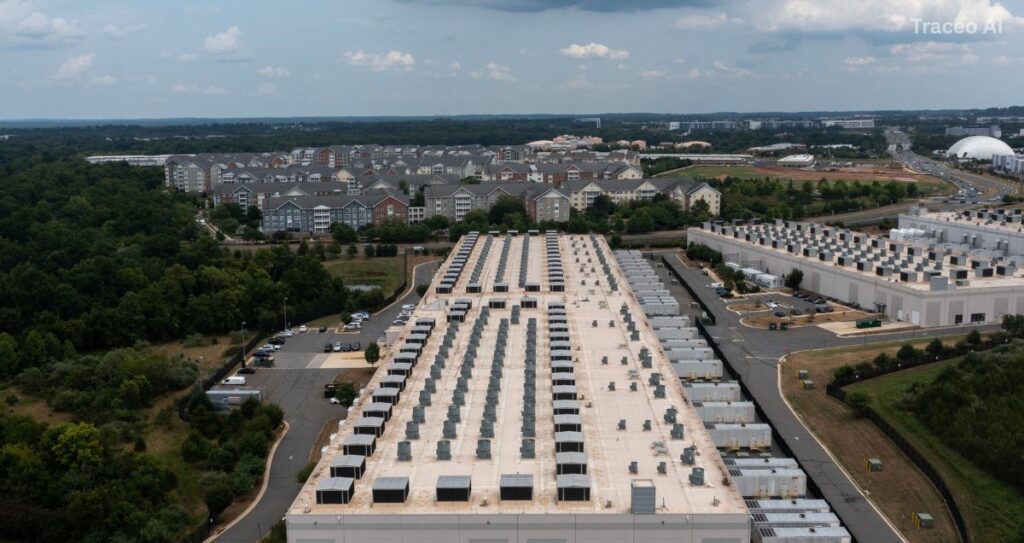
For all the momentum behind Omen’s pitch, it’s worth being clear-eyed about what a $31 million Series A actually proves and what it doesn’t. A dozen pilot customers is meaningful early validation, but it’s a small sample relative to the thousands of data center facilities now being built or retrofitted for AI workloads worldwide, and Omen hasn’t disclosed how its sensors perform across the full range of fluid chemistries operators actually use — different facilities run different additive blends, at different concentrations, on different schedules, and a sensing platform tuned for one combination may need real engineering work to generalize cleanly to the next. Real-time spectroscopy is also a fundamentally probabilistic exercise: it’s reading light absorption and scattering patterns and inferring chemical composition from them, which means false positives and false negatives are an engineering reality to be minimized, not eliminated outright. An operator who shuts down a rack based on a false alarm pays a real cost too, just a smaller one than a surprise biofouling event.
There’s also the matter of competition arriving from a very different direction. Pyxis brings decades of institutional knowledge in water treatment chemistry and existing relationships with facilities teams who already trust its testing protocols — assets that are hard for a four-year-old hardware startup to replicate quickly, even with $40 million in the bank. Whether the market ultimately favors an outside challenger with a more advanced sensor and software stack, an incumbent extending its existing water-treatment relationships into a new vertical, or some combination of both — incumbents buying the sensing technology rather than building it — is still an open question that this funding round doesn’t settle.
Finally, there’s a structural risk common to almost every company selling into the current AI infrastructure boom: a meaningful share of Omen’s near-term growth is tied to how fast hyperscalers and neoclouds keep building new liquid-cooled capacity. If the pace of AI data center construction were to slow — because of a pullback in AI capital spending, a shift in chip architecture that reduces cooling demands, or some other disruption — the addressable market for coolant monitoring would shrink along with it. That’s a risk shared by virtually every vendor in this space, from generator makers to GPU cloud providers, but it’s worth naming directly rather than assuming the current growth curve simply continues in a straight line.
What comes next
Omen’s near-term plan, by its own account, is to keep building out the data center side of its business alongside its existing industrial and construction-equipment customers, using the fresh capital to scale manufacturing of its sensor hardware and to refine the signal-processing layer that turns raw spectrometer readings into actionable alerts. With roughly a dozen data center customers already in the fold, including a high-profile AMD-based cloud provider in TensorWave, the company has real-world deployments to draw on as it tries to convince the rest of an industry still largely reliant on mailed lab samples that continuous chemical monitoring is worth the investment.
Whether Omen, Pyxis, or some other entrant ends up defining how the industry monitors its coolant, the underlying trend looks durable. As GPU thermal loads keep climbing and rack densities keep pushing past the limits that made air cooling viable, the fluid running through a data center’s veins is no longer a background utility — it’s a variable operators need to manage as carefully as the power coming in or the chips doing the computing. The race to build smarter, cheaper, faster AI infrastructure increasingly runs through unglamorous plumbing problems like this one. For an industry obsessed with chips and compute, the irony is that one of its more important emerging fights is, quite literally, all wet.

